

Key takeaways of the BNP Paribas Global Markets Conference 2025
• Europe’s re-orientation towards strategic autonomy was the top talking point
• AI: Entering bubble territory or the dawn of a new technology era? The debate continues…
• Private credit challenges the credit crunch narrative
Europe is taking bold steps toward strategic autonomy—accelerating investment in defence and technology to navigate today’s volatile world. With fiscal discipline as a guiding principle, policymakers have a clear roadmap: the Draghi Report’s recommendations and the Savings and Investments Union (SIU) offer a powerful framework to unlock further progress. By building on this momentum, Europe can turn ambition into action—ensuring resilience and leadership for the future.
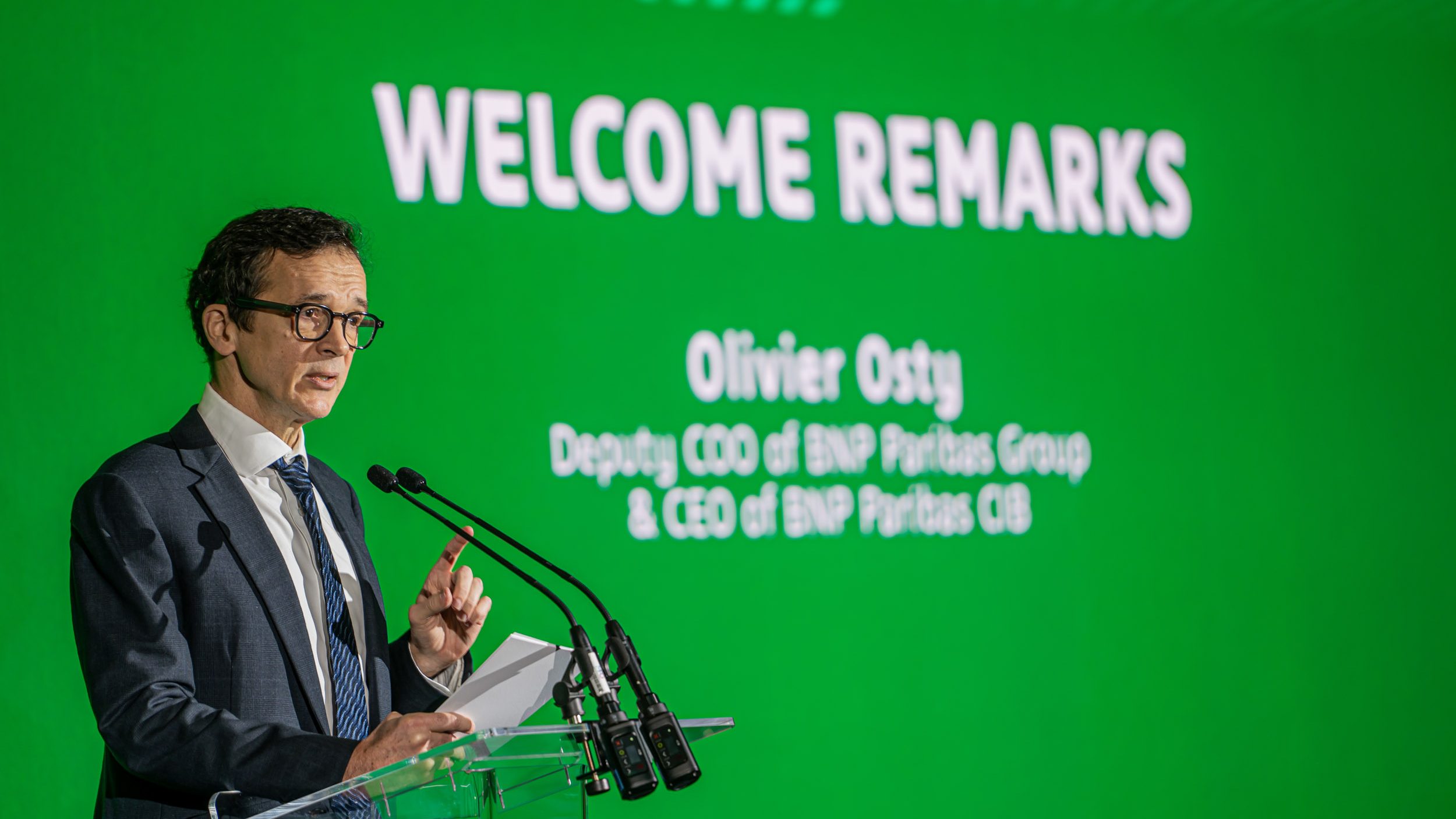
“In 2025, the rebalancing of power and finance in the world has seen Europe emerge into the global spotlight both as a catalyst for growth but also as a region confronting new geopolitical challenges. This year’s BNP Paribas Global Markets Conference is about helping our clients navigate these challenges” said Olivier Osty, Deputy COO of BNP Paribas Group, CEO of BNP Paribas CIB.
During the BNP Paribas Global Markets Conference 2025, leaders from politics, financial services, academia and technology shared their insights on these issues.
Europe’s strategic autonomy dominates discussions at BNP Paribas Global Markets Conference 2025
European defence and security were recurrent themes at the conference.
One former leader said Europe has for a long time now assumed peace on the continent would be permanent, prosperity assured, and that the US security guarantee was iron-clad.
Europe is waking up to the new security paradigm, and is looking to attain strategic autonomy. Whereas previously, a lot of NATO members were spending less than 2% of their GDP/year on defence, a former UK government minister said several European countries have corrected course – and are now planning to ramp up defence spending to 3.5% of GDP.
“Europe must answer some questions about its place in the world, what it stands for, and what it is to become,” said Emmanuelle Bury, UK Country Head, BNP Paribas.
In addition, unlike the US and China, both of which have booming technology industries, Europe is lagging behind, commented experts at the BNP Paribas Global Markets Conference 2025. If Europe is to compete, then it will need to implement some major structural reforms.
To become more competitive, the EU needs to onboard the recommendations made in the Draghi Report and push ahead with the Savings and Investments Union (SIU), an initiative designed to stimulate its capital markets, said panellists.
The Draghi Report, which was published in 2024, advised the EU to increase spending by $750 billion – $800 billion each year between now and 2030 if it is to meet its obligations around defence, technology and sustainability. The report also urged the EU to cut back on red tape.
However, progress has been slow, with Paul Hollingsworth, Head of DM Economics, Global Markets, BNP Paribas, saying that the EU’s implementation of the Draghi Report’s recommendations is taking a long time.
On SIU, positive changes are happening. This was underlined by Isabel Schnabel, Member of the Executive Board, European Central Bank (ECB), who said she fully supports the EU’s proposal for a so-called 28th Regime, a single harmonised legal framework that companies can opt into instead of having to comply with the EU’s 27 different regulatory regimes. “I am a big fan of the 28th Regime, as it will make it easier for businesses to scale up in the EU,” she continued.
Europe is also well-positioned from a macro perspective, experts told the BNP Paribas Global Markets Conference 2025. Despite lingering concerns about sovereign debt, Luigi Speranza, Global Head of Markets 360 and Chief Economist, BNP Paribas, cited comments made by ECB Chair Christine Lagarde, who said the Eurozone’s economy is in a ‘good place.’
AI: Revolution or Bubble?
AI, a technology which has become increasingly embedded in our daily lives, was covered extensively at this year’s BNP Paribas Global Markets Conference 2025.
Depending on who you ask, AI is either a bubble waiting to burst, on the cusp of a Fourth Industrial Revolution, or a little bit of both. However, despite bubble fears, a technologist said AI still has a lot going for it.
They said that while some AI companies are burning through a lot of cash, they are still generating healthy revenues. Although there are striking parallels between what is happening in today’s equity markets and 1999/2000, the technologist told the BNP Paribas Global Markets Conference 2025 that AI company valuations – whilst high – are nowhere near the levels seen during the peak of the dotcom bubble.
Citing comments made by Amazon Founder Jeff Bezos, one asset manager described AI as being a ‘good bubble.’ “We should separate the potential impact on bond and equity markets from the real economy and the innovation that will come out of it,” they said.
The technology’s impact is being felt in the asset management industry too, said Conor Davis, Global Head of Institutional Sales & Investors, BNP Paribas, moderating a panel of investors.
A fund manager noted that investment research and portfolio construction are ripe candidates for disruption by AI. “We know there are research agents out there, which a few large asset managers are deploying. There are also fintechs in the market which are managing money based on AI-enabled research agents,” they continued.

Private capital…Are cracks indicative of something larger? Or idiosyncratic events?
Private Credit bubble headlines have flooded the media following recent Tricolor and First Brand news. John Gallo, Head of Global Markets Americas, Global Head of Corporate and Institutional Client Group, BNP Paribas, posed the bubble question in conversation with the President of a marquee asset manager and the audience received some great insights into the industry wide hot topic.
An alternative asset manager said private credit is being unfairly targeted, highlighting that private credit and syndicated credit at banks are indistinguishable from each other, before adding that recent events are “idiosyncratic and typical late cycle behaviour.”
Europe stands at the threshold of a defining era—one where security, technology, and global leadership converge. The transatlantic alliance, a cornerstone of stability for eight decades, now faces new tests, while the war in Ukraine and the AI revolution reshape the world’s economic and geopolitical landscape. This is the moment for Europe to reimagine itself. By embracing structural reform, there is nothing to stop Europe from achieving the strategic and technological autonomy required to thrive in the new world order.
Attended by 722 of the bank’s institutional and corporate clients, BNP Paribas Global Markets Conference 2025 was an excellent opportunity for colleagues and clients to both reconnect and gain invaluable insights into some of the main dynamics influencing geopolitics and markets today.