

Key Takeaways
• Stronger growth is keeping U.S. interest rates higher: AI investment and resilient consumer spending are supporting the U.S. economy, limiting the scope for lower Treasury yields
• The AI investment boom presents opportunities and risk: Heavy spending on infrastructure is supporting growth, but rising borrowing and uncertainly over future returns could put pressure on credit markets
• Investors face a less predictable markets environment: Geopolitical tensions, U.S. fiscal policy and changing Federal Reserve communication could challenge traditional investment strategies.
How much higher can U.S. interest rates go before economic growth starts to feel the pressure?
This was one of the central questions at BNP Paribas’ Policy & Markets Boston 2026 conference, where institutional investors and markets experts gathered to examine the forces sharping financial markets.
The event brought together Markets 360 strategists and industry experts to discuss the outlook for U.S. interest rates in 2026, the growing influence of artificial intelligence (AI), credit market risks and the impact of geopolitical uncertainty.
Across sessions, a common theme emerged: the U.S. economy has proved more resilient than many expected, but forces supporting that growth are also creating new risks for investors.


Why are U.S. Treasury yields rising?
Panelists highlighted that stronger economic growth, rather than inflation alone, has become the main driver of higher U.S. Treasury yields.
Guneet Dhingra, Head of U.S. Rates Strategy suggested that 80% of the recent rise in yields reflects an improved growth outlook, with the remaining 20% linked to inflation.
A major contributor is the scale of investment in AI infrastructure, panelists emphasized. Spending on data centers, computing capacity and related technology is supporting economic activity, even as borrowing costs remain elevated.
This resilience is changing expectations for the U.S. interest rates outlook.
What does this mean for future U.S. interest rate hikes?
Panelists see scope for further Federal Reserve rate hikes as policymakers respond to persistent inflation and strong growth. The discussions also questioned whether interest rates are as restrictive as previously assumed.
Panelists agreed that strong household wealth, relatively low fixed mortgage costs and healthier corporate balance sheets have helped cushion the economy from higher rates. Consumer spending and employment will be important indicators of whether this resilience can continue.
The question for investors is no longer simply when rates might fall, but how high they may need to rise before growth begins to slow.
Can the AI investment boom sustain its momentum?
AI was a recurring theme throughout the conference, with speakers broadly positive about its long-term potential but more cautious about the pace of investment.
History offers a useful comparison. The expansion of telecommunications infrastructure in the late 1990s ultimately helped transform the economy, but significant investment arrived before demand and revenues could justify it.
AI may face a similar challenge.
Companies are committing substantial capital to infrastructure without knowing exactly when that spending will translate into profits. As businesses gradually adopt AI and find more cost-effective ways to use it, demand may develop differently from current expectations.
This creates an important distinction between companies with strong finances and those relying heavily on borrowing.
The panel highlighted that while AI technology could deliver lasting productivity gains, not every company financing its development will necessarily benefit.
For investors, understanding where revenues will ultimately be generated, and which businesses can withstand delays, will be critical.
How is AI-related borrowing changing credit markets?
One panel highlighted how the financial impact of AI investment is becoming increasingly visible in corporate bond markets.
BNP Paribas speakers suggested that borrowing by major technology companies, known as hyperscalers, could rise from $250 billion in 2026 to $400 billion in 2027.
This increased supply is expected to put pressure on investment-grade credit spreads, the additional yield investors demand for holding corporate bonds rather than government debt.
Although demand for corporate bonds remains healthy, panelists expect new issuance to grow faster than investor appetite.
What are the risks for lower-rated credit?
Risks are also emerging in lower-rated credit. Some speakers warned that companies facing higher refinancing costs or relying on future AI-related revenues could be particularly vulnerable.
The outlook is not uniformly negative. Panelists identified potential for a near-term recovery in credit markets, particularly in stronger companies, before renewed borrowing adds pressure in 2027.
The implication is a more selective market, where financial strength and the ability to refinance debt matter increasingly.
How could geopolitics and Fed policy change the market outlook?
Beyond AI, speakers highlighted two important sources of uncertainty: geopolitical development and the direction of U.S. economic policy.
Escalating conflict in the Middle East, particularly disruption to energy infrastructure could affect inflation and global growth. Meanwhile, fiscal pressure in the U.S. and Europe may create opportunities for investors as markets reassess political and economic risks.
What are the Fed priorities under Kevin Warsh?
In the U.S., attention turned to Federal Reserve Chair, Kevin Warsh and his approach to monetary policy.
The discussion suggested that Warsh places particular emphasis on price stability and may be less willing to guide markets toward a predicable path for interest rates.
Rather than assuming the Fed will alternate between rate hikes and pauses, panelists noted that investors may need to prepare for a fast pace of tightening if inflation remains persistent.
U.S. government financials present another challenge. With annual budget deficits of approximately $2 trillion, speakers questioned whether either political party would introduce meaningful fiscal restraint following the midterm elections.
Continued government borrowing could place additional upwards pressure on long-term interest rates, particularly if economic growth slows.
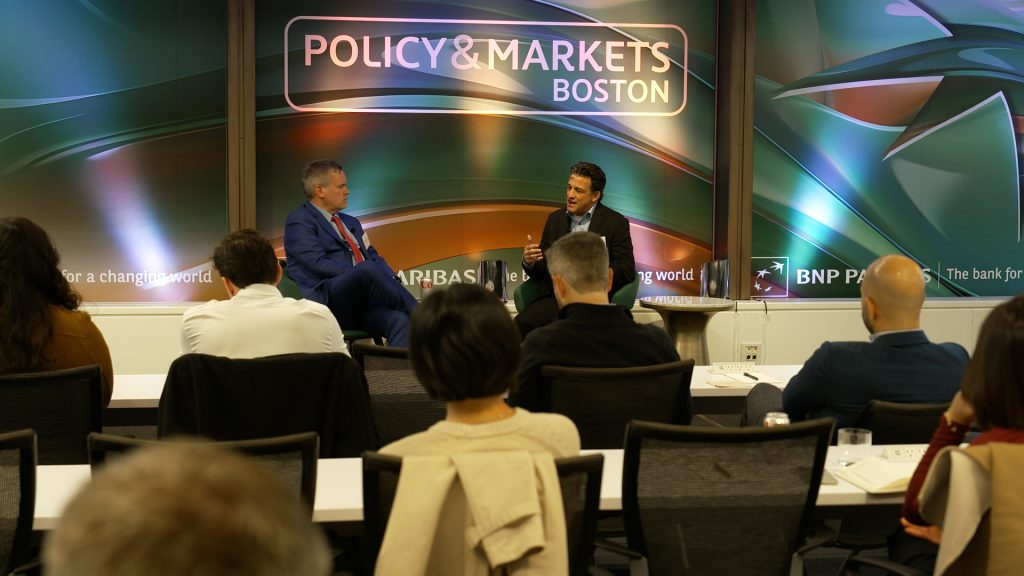
Policy & Markets Boston 2026: What does this mean for institutional investors?
The discussions at Policy & Markets Boston 2026 pointed to an economy supported by strong investment and resilient spending, but one in which the risks are becoming more complex.
AI could provide lasting support for productivity and growth, yet its expanding financing requirements may challenge credit markets. Meanwhile, higher interest rates, political uncertainty and changing relationships between asset classes are making traditional assumptions less reliable.
For investors, the priority will be to look beyond broad market trends, understand where risks are concentrated and distinguish between companies’ positions to benefit from long-terms growth and those exposed to its potential setbacks.
| FAQ |
| What is Policy & Markets Boston 2026? Policy & Markets Boston is BNP Paribas’ annual proprietary conference that brings together institutional clients to discuss the latest topics and themes affecting U.S and global financial markets. The event includes a series of panels with BNP Paribas experts and industry leaders to gain their perspectives on what’s driving markets today. Policy & Markets Boston is part of a wider series with conferences taking place in Boston, Miami and Indian Well (as part of the BNP Paribas Open Summit). |
| Why is Policy & Markets Boston 2026 important? Policy & Markets Boston provides an opportunity to hear from industry leaders on the most pressing topics in markets and hear directly from BNP Paribas’ experts on their view. It also brings together industry professionals to network and share ideas. |
| What were the main themes at Policy & Markets Boston 2026? The main themes discussed at Policy & Markets Boston 2026 included U.S interest rates in 2026 and credit markets, the impact of AI on financial markets, the state of the U.S economy and the Federal Reserve outlook under Kevin Warsh. |