

Key Takeaways: The three bears of AI and regulation in 2026
• Safety: Increasing regulatory oversight on “frontier” models may narrow the commercial gap between proprietary and open-weight AI.
• Infrastructure: Physical constraints, specifically power grid limitations and local opposition (NIMBYism), are becoming primary bottlenecks for the global AI data centre expansion.
• Geopolitics: The rise of “Sovereign AI” and intensifying US-China tech rivalries are fragmenting the global AI landscape, creating new compliance hurdles and supply chain constraints.
Navigating AI and regulation in 2026 has become a critical challenge for leaders with the AI-driven data-centre boom now a multi-trillion dollar story. This explosion in compute demand is colliding with an unprecedented surge in AI data‑centre power demand, forcing a reckoning between speed and oversight.
In their report “Goldilocks AI and The Three Bears”. the BNP Paribas Equity Research affirm that the market’s trajectory will be dictated less by technology than by three regulatory forces: safety, infrastructure, and geopolitics. Each bear can either accelerate the build‑out or choke it, and together they determine whether the sector ends up in a balanced Goldilocks world, a hot “boom” path, or a cold “slow‑down” outcome.
1. Safety – The first “bear” of AI and regulation in 2026
Regulatory momentum
Safety concerns have moved from a fringe discussion to a central policy agenda. In August, the White House finalised its framework for testing pre-release frontier AI models, with developers voluntarily giving the federal government access to their most advanced models up to 30 days before release to enhance their security. State‑level actions – California’s SB 813 and New York’s RAISE Act – create independent verification bodies and registries for AI systems. The EU AI Act, already in force, imposes risk‑based obligations on high‑impact models.
Potential impact on capacity
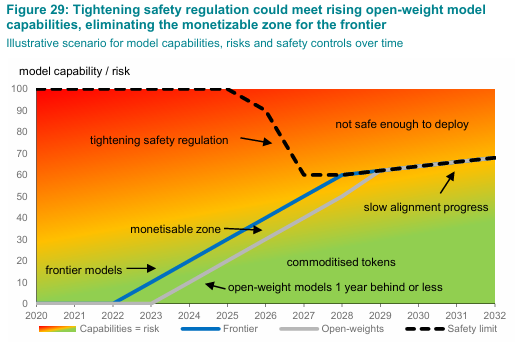
The report stresses that safety regulation could eliminate the monetizable zone for frontier models. Frontier models have value by being more capable than open weight models but still safe enough to deploy. But safety controls could allow open-weight models to catch up, as we illustrate in the figure below.
2. AI infrastructure and regulatory risks – the second “bear”
Power as the limiting factor
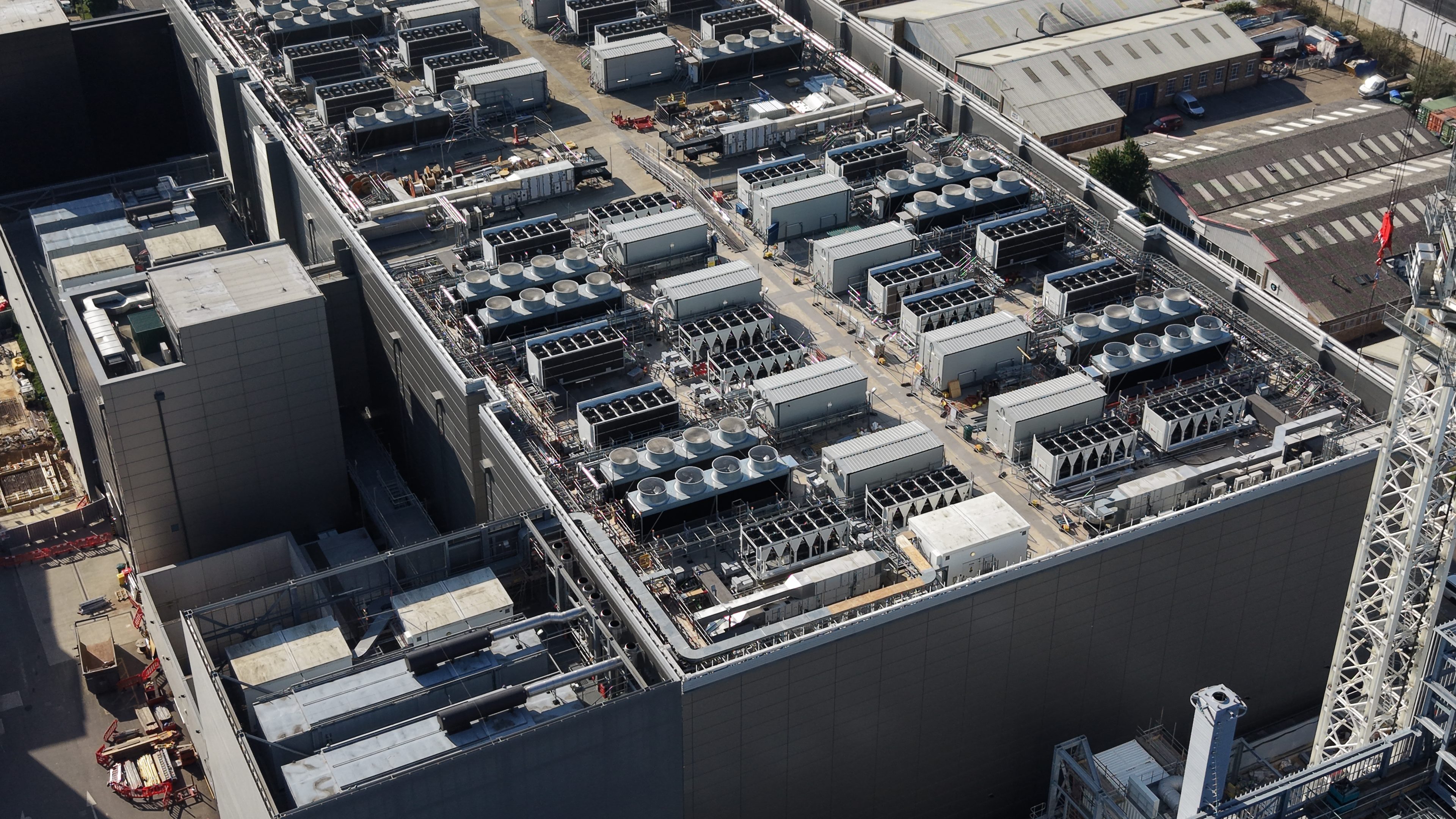
The US retains a dominant share of new IT data centre projects but the power‑grid is their primary constraint. Utilities face long lead times for new transmission lines, substations, and gas‑turbine generation, especially in high‑growth regions such as Texas and the Mid‑Atlantic. Data centre power demand is a less dominant driver of overall electricity demand in Europe than the US. However, we are already seeing more data centre power agreements coming to Europe, perhaps helped by US power bottlenecks and regulatory risks. As for China, its data‑centre expansion is powered by ultra‑cheap electricity (≈ $0.04 /kWh) from state‑owned coal and renewables, allowing a faster rollout of compute. However, the country’s grid reliability and regional transmission constraints could become limiting factors as AI demand grows.
Moratoriums and NIMBYism
In the US, data‑centre moratoriums have risen with 120 projects worth valued at $200 bn blocked or delayed in H1 2026 alone, according to Data Centre Watch. NIMBYism (Not In My Back Yard) – when local residents oppose new developments or public projects in their own neighbourhood – certainly spread across the US, with data centres increasingly a focal point in local politics. The analysts see these societal trends as a potential headwind for growth if they remain pervasive.
Regulatory levers
The Federal Energy Regulatory Commission (FERC) recently ordered all six U.S. regional grid operators to justify or reform large‑load connection rules, highlighting the policy relevance of power‑infrastructure bottlenecks. State‑level policies (e.g., New York’s 1‑year moratorium on >50 MW permits) could further delay projects.
3. Geopolitics – the third “bear”
There are 4 major geopolitical issues impacting AI and regulation in 2026:
- US‑China rivalry: The US is pursuing a “full‑stack AI supremacy” strategy, including export controls on advanced chips and a push to domesticate the AI supply chain. Conversely, China is rapidly expanding its AI‑centric power infrastructure and leveraging open‑weight models.
- Export‑control legislation: The proposed MATCH Act (The Multilateral Alignment of Technology Controls on Hardware Act: aims to tighten export controls among allies) would give Washington unilateral authority to block the sale of “chokepoint” equipment (e.g., immersion DUV lithography) to non‑aligned jurisdictions, threatening European equipment makers.
- Sovereign AI push: Europe’s “AI Continent” ambition and the EU AI Act create a parallel regulatory regime that could spur domestic data‑centre build‑out, but also increase compliance costs for multinational vendors.
In addition, we also see national‑security constraints emerging: the Department of War’s demand for “US‑only” frontier‑model access and the requirement for U.S. citizens to use domestically‑hosted models could hamper global infrastructure build out or frontier model monetisation.
Navigating AI and regulation in 2026 requires more than just computational scaling; it demands a “Goldilocks” equilibrium between rapid innovation and essential oversight.
The industry must manage three critical “bears”: the regulatory constraints of safety, the massive physical requirements of infrastructure, and the fragmentation caused by shifting geopolitics. It’s these three bears of regulation that will determine whether the AI data-centre market – the key driver to AI growth – will be propelled into a hot expansion, or stalls into a cold slowdown.
FAQs
What are the three main drivers of AI regulation in 2026?
According to BNP Paribas Equity Research, the trajectory of the AI market is dictated by three regulatory forces, referred to as the “three bears”, Infrastructure, and Geopolitics.
How does AI safety regulation affect the competitiveness of AI models?
Safety regulations, such as the EU AI Act and White House frameworks, impose strict testing and security requirements on “frontier” models. These controls may narrow the commercial advantage of high-end proprietary models by allowing safer, open-weight models to catch up, potentially altering the industry’s monetisation landscape.
What are the primary infrastructure risks for AI data centres in 2026?
The most significant infrastructure risks include power grid limitations, long lead times for utility upgrades, and local opposition known as NIMBYism. In the US, these factors have already led to significant project delays and moratoriums, impacting the ability to scale compute capacity.
BNP Paribas does not consider this content to be “Research” as defined under the MiFID II unbundling rules. If you are subject to inducement and unbundling rules, you should consider making your own assessment as to the characterisation of this content. Legal notice for marketing documents, referencing to whom this communication is directed.