

Key Takeaways
• The Science Based Targets initiative (SBTi) framework for carbon credits is embedded in the newly released ‘Corporate Net‑Zero Standard Version 2.0’ (CNZS V2.0). This introduces an Ongoing Emissions Responsibility (OER) programme that clarifies how companies should engage with the emissions they cannot eliminate.
• In this framework, a clear hierarchy is established, with decarbonization within a corporate’s activity as the primary pathway, and climate contributions as a complementary responsibility.
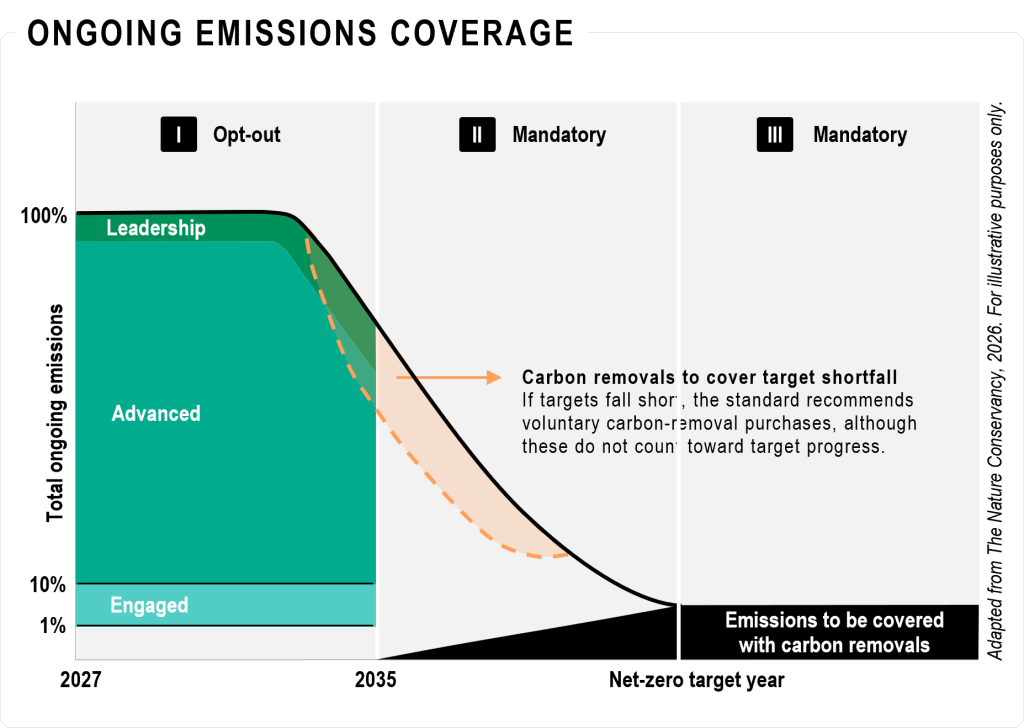
• The OER framework is structured in three phases: an initial voluntary recognition phase, for which corporates must declare their intent should they wish to opt-out, followed by a progressive transition toward minimum contribution requirements starting in 2035, and ultimately a net-zero phase where companies are expected to fully neutralise their residual emissions through eligible carbon removals.
• The framework places strong emphasis on high-integrity carbon credits, meaning that only verified mitigation outcomes meeting existing high-integrity frameworks are considered eligible, effectively raising the bar for what qualifies in corporate climate strategies.
The new SBTi framework for carbon credits
The latest SBTi rulebook, presented as the Corporate Net‑Zero Standard Version 2.0, includes a framework for ‘Ongoing Emissions Responsibility’ (OER).
Companies are encouraged to address an increasing share of their ongoing unabated emissions each year through climate contributions, ultimately reaching full coverage at net-zero. In the case of companies that do not intend to take part, an explanation must be submitted via an opt-out transparency rule
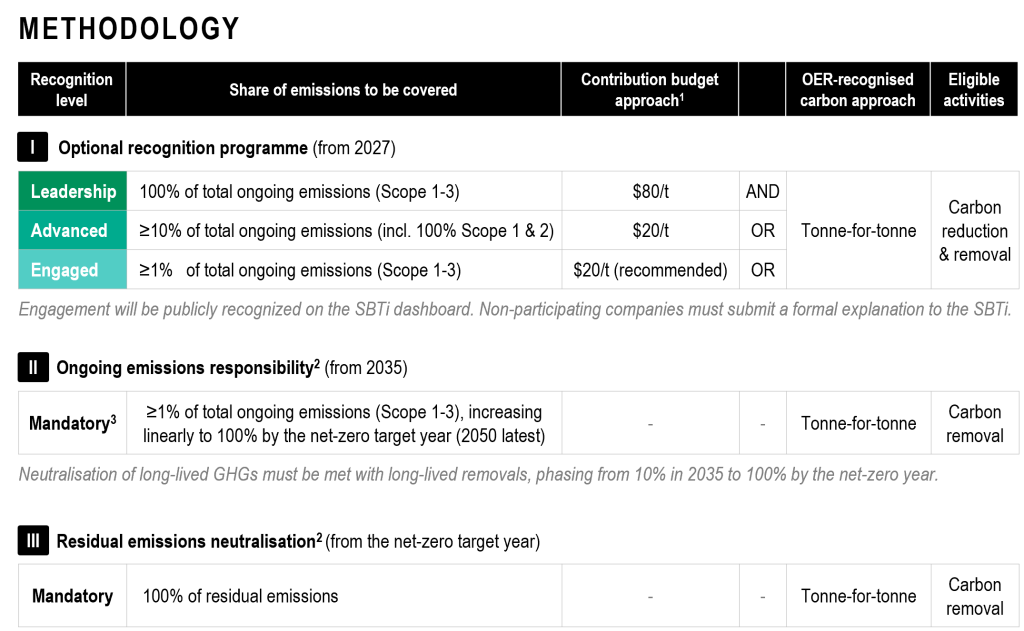
Under this structure, companies can be publicly recognised if sufficiently advanced in the process of setting their SBTi targets – attaining an ‘Engaged’, ‘Advanced’ or ‘Leadership’ engagement level.
The role of the Carbon Credit Market within the Corporate Net‑Zero Standard Version 2.0
In practice, this means companies voluntarily tackle ongoing emissions ahead of their net-zero deadlines by making contributions to climate mitigation as a proportion of the volume of their emissions. The most direct form this takes is the purchase of high-quality carbon credits, which represent verified emissions mitigation outcomes, such as:
- External emissions reductions, for instance methane abatement projects or industrial efficiency improvements.
- Protection and enhancement of natural carbon sinks, such as afforestation and reforestations projects that plant native tree species on degraded land and blue carbon ecosystems, that restore coastal mangrove forests.
Companies can also make a financial contribution, which is implicitly linked by the framework to a carbon price, meaning they are expected to allocate funding on a per-ton basis, effectively translating their residual emissions into a monetary cost that reflects an internalised price of carbon.
The SBTi does not seek to replace existing carbon credit and climate contribution frameworks. Instead, this chapter establishes minimum criteria for companies to be recognised under the OER framework. The SBTi has noted it will develop criteria and processes to recognise relevant third-party frameworks, standards, and programs where applicable.

The OER framework is a significant step forward, providing the clarity corporates have long needed on how carbon credits fit within science-based targets. To secure the highest-quality credits at competitive pricing, companies must start building their supply pipelines now, well before retirement obligations kick in.
Constance Chalchat, Chief Sustainability Officer, Global Markets, BNP Paribas
High‑integrity carbon credits as a complementary tool
What distinguishes the OER framework is its explicit openness to high‑integrity carbon credits as a complementary tool. While the core science‑based target continues to be met through absolute emission reductions, companies may now allocate a portion of their ongoing emissions budget to verified removal credits that deliver durable, long‑lived storage of CO₂. Until the net-zero year is reached, the framework separates these supplementary actions from the main target, ensuring that the primary ambition of reducing emissions at source remains untouched.
In practice, the OER framework creates a dual pathway for corporates:
- First, continue the trajectory of absolute reductions across all scopes.
- Second, complement the non-abated emissions with premium removal credits that meet the new integrity criteria. This arrangement is expected to generate a steady, predictable demand for high‑quality removals and to attract additional liquidity to the voluntary market.

The practical implication of the CNZS V2.0 is that corporates no longer have to choose between strict decarbonization and external climate action. We are seeing a shift where companies can now integrate high-integrity credits into their broader transition strategies as a complementary tool. This provides the necessary clarity for firms to scale their climate contributions without compromising the integrity of their primary SBTi targets.
Sebastien Decerf, Commodity Trading – Carbon Portfolio Management, Global Markets, BNP Paribas
The 2035 obligation deadline for carbon credits
The new SBTi framework for carbon credits will take effect on 31 January 2027, with a transition period between Q1 2027 and Q1 2028, but certain companies with validated science‑based targets will be required to comply with parts of the new standard only from 2035. From 2035 onwards, large and medium‑sized companies in high‑income countries that participate in the framework are expected to address a defined share of their ongoing emissions through carbon removals and solutions that deliver long‑lived carbon storage.
Over time, this progression converges with the net-zero requirement: by the time companies reach their net-zero target year, they are expected to fully neutralise their residual emissions, typically through long-lived carbon removals.
As such, the post-2035 phase represents a key inflection point, marking the transition from a predominantly voluntary framework toward a more structured obligation for companies to take responsibility for their remaining emissions on the path to net-zero.
Comparison of the historic SBTi approach with the new Corporate Net‑Zero Standard Version 2.0
| Aspect | Previous SBTi Framework | New SBTi Framework (CNZS V2.0 / OER) |
| Core philosophy | Emphasis on absolute emissions reductions across Scopes 1‑3; carbon credits could not be used to meet near‑term science‑based targets. | Adds a supplementary “Ongoing Emissions Responsibility” (OER) pathway that recognises high‑integrity carbon‑removal, reduction and avoidance credits as complementary actions, reported separately from the core target. |
| Treatment of ongoing emissions | Ongoing emissions were acknowledged as inevitable but were not eligible for any credit‑based offsetting; companies were expected to keep reducing them until residual emissions appeared at the net‑zero year. | Companies may voluntarily take early responsibility for a share of ongoing emissions before the net‑zero year through the optional recognition programme. |
| Use of carbon credits | Carbon‑removal credits could only be applied at the net‑zero target year to neutralise residual emissions. Credits for emissions‑avoidance or reduction were not counted at all. | The OER framework permits the use of high‑integrity removal credits and also emission‑reduction/avoidance credits as supplementary actions. These actions are reported separately and do not count toward the primary science‑based target. |
| Voluntary recognition | No formal label for companies that voluntarily addressed ongoing emissions; companies simply disclosed extra climate contributions. | Companies sufficiently advanced in their SBTi target process setting can be publicly recognised – with an Engaged, Advanced or Leadership label – for voluntarily taking responsibility for their ongoing emissions ahead of their net-zero target year. |
| Mandatory removal requirement | No mandatory requirement to use removals before the net‑zero year; only residual emissions at the net‑zero year had to be neutralised. | From 2035 onward, large and medium‑sized firms in high‑income economies must address a minimum share of ongoing emissions with durable carbon removals (progressively to 100% at the net‑zero year). |
| Progressive removal share | Not defined; removal was a one‑off neutralisation at the net‑zero year. | The share of ongoing emissions offset by removals increases each year after 2035, with a design to reach full coverage of residual emissions by the company’s net‑zero target year. |
| Financial‑budget vs mitigation‑impact options | Only a mitigation‑impact route existed (direct purchase of removal credits at the net‑zero year). | Two compliance routes are now available: • Financial‑budget approach – apply an internal carbon price and channel the budget to eligible climate‑finance actions. • Mitigation‑impact approach – directly deliver verified mitigation outcomes equal to the required share of covered emissions. |
| Verification requirement | Limited verification focused on the primary science‑based target. | Independent third‑party limited‑assurance verification is required for both the integrity of the climate‑finance budget (if used) and the actual mitigation‑impact contributions under OER. |
| Reporting | Ongoing emissions and any supplementary actions were reported together. | OER actions are reported separately from the core science‑based target, aligning with upcoming GHG‑Protocol guidance and enhancing transparency. |
| Stakeholder signaling | No formal label; companies relied on narrative disclosures. | The Engaged, Advanced and Leadership labels provide a public signal of ambition, differentiating firms that take early voluntary action from those that wait for the mandatory date. |
How BNP Paribas can help clients navigate the transition
BNP Paribas offers an end‑to‑end suite of carbon‑credit services:
- Project sourcing and inventory management – including its own carbon credits portfolio and access to main registries.
- Primary‑market financing, such as inventory refinancing and outcome‑bond structures which provide a way to secure future access to high-quality carbon credits while enabling upfront financing of projects.
- Secondary‑market trading and hedging, and structured solutions for carbon credit products.
These capabilities, combined with a broad diversity of project types and global geographic coverage, help enable our clients to meet their OER obligations with transparency and price certainty.
Explore BNP Paribas Global Markets’ sustainability hub to discover our market‑based solutions for building a more sustainable economy.
FAQ’s
What are ongoing CO₂e emissions?
They correspond to the greenhouse gas emissions across scopes 1, 2, and 3 that continue to be released into the atmosphere within a company’s target timeframe, i.e. before it reaches its net-zero deadline (if any).
What are carbon credits?
Carbon credits are certificate units representing one ton of CO₂ equivalent that has been reduced, removed, or captured. They enable companies to compensate for residual emissions by recognising the environmental benefit of verified emissions reductions or removals. Carbon credits can be issued by a wide array of activities including Nature Based Solutions, Engineered Based Solutions, or Energy Efficiency.
What is the OER in the new SBTi framework for carbon credits and who can use it?
The OER is a structured framework that dictates how companies must address and take financial responsibility for the greenhouses gases they continue to emit while transitioning towards their net-zero objective.
The OER starts with a tiered recognition program that recognizes companies that cover a defined share of these ongoing emissions through climate contributions that support verified mitigation and other climate actions beyond their validated target requirements. This includes any carbon avoidance, reduction or removal credits.
When does the mandatory removal share start and how does it progress?
The mandatory ongoing emissions responsibility starts in 2035 for large and medium sized firms in high income markets. From 2035, these companies shall take responsibility for at least 1% of their ongoing emissions through carbon removals. This minimum share shall increase linearly to 100% by the company’s net-zero target year, and no later than 2050 and include a defined and increasing share of long-lived removals.
Which credits count toward the mandatory OER share?
When OER participation becomes mandatory, the eligibility rules tighten significantly. Avoidance and reduction credits will no longer qualify. Only verified carbon removal credits will count towards the mandatory OER percentage. In addition, companies are expected to transition towards long-lived removals, starting at 10% in 2035 and scaling to 100% at net-zero. Across both phases, credits used for the OER can never be double-counted or blended to meet a company’s own near-term reduction targets. Of note, the SBTi is expected to develop criteria and processes aligned with existing high-integrity frameworks.
What are the two compliance routes companies can follow under the new SBTi framework?
Financial budget route: apply an internal carbon price (floored at USD 80/tCO₂e for companies seeking the ‘Leadership’ attribution) to each ton of covered emissions and allocate the resulting budget to eligible climate finance actions.
Mitigation impact route: deliver ex-post verified removal outcomes that meet the volume of covered emissions.
Both routes will require limited assurance third party verification.
How can BNP Paribas help companies meet the new SBTi framework for carbon credits requirements?
BNP Paribas Global Markets offers a full-stack solution leveraging our trading, structuring and financing capabilities. Solutions span throughout project sourcing and inventory management, primary market financing (inventory refinancing, outcome bond structures), Secondary market trading & hedging (cleared & OTC, bespoke strategies), verification & reporting.