

For Swiss corporates, hedging has always posed a challenge due to the strength of the Swiss Franc as a safe haven currency, and the high cost of carry against all major currencies. This year, FX volatility, the Franc’s strong rise against a weakened US Dollar and the low rates environment have amplified the issue as Swiss companies weigh up the cost of hedging in a market defined by volatility and geopolitical uncertainty.
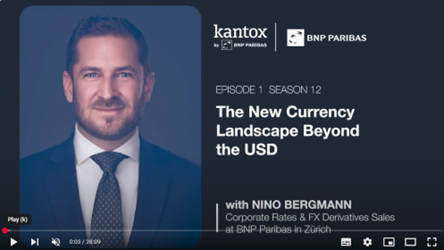
Nino Bergmann, Corporate Rates & FX Derivatives Sales at BNP Paribas speaks to Kantox about the current challenges faced by Swiss corporates.

Swiss macro view: then vs now
When looking at the macro environment last year, the primary focus was on inflation and the responses of central banks. Rates were still on the rise, and uncertainty loomed large over how far central banks – particularly the Fed and the ECB – would go in their tightening policies.
The Swiss National Bank (SNB) was also tightening, albeit in a more measured manner. At that time, interest rates were expected to remain high for an extended period, and there was significant volatility in foreign exchange markets, with the US Dollar maintaining its strength.
Fast forward to the present day, and the landscape has shifted notably. Inflation has subsided in most major economies, and central banks began to adjust their policies. The SNB took the lead on cutting rates, a decision influenced not only by the decline in Swiss inflation but also by the enduring strength of the Swiss Franc, which exerts downward pressure on prices.
A challenge for Swiss exporters
For Swiss corporates, especially those involved in exports, this new environment presents a different set of challenges. While lower interest rates aid in reducing financing costs, the stronger Franc is becoming a significant headwind, particularly against the Dollar.
This puts pressure on profit margins and competitiveness in key export markets. “What makes it even more crucial for Swiss exporters and its treasury functions is the constant appreciation of the CHF franc, being a safe haven currency as we all know, as well as its interest rate differential leading to heavily negative carry effect”, explains Bergmann.
Additionally, new risks are emerging. Global trade is becoming more fragmented, with supply chains shifting and protectionist policies on the rise. Geopolitical tensions remain elevated, adding to the overall uncertainty. Moreover, increased regulatory complexity, particularly around cross-border compliance, is starting to impact how companies operate internationally.
Managing FX volatility in the current environment
Compared to last year, the approach to risk management has evolved. A year ago, the focus was on protecting against sharp rate hikes or sudden movements in foreign exchange rates. Today, the emphasis is on staying agile – balancing risk and opportunity, managing FX volatility and exposures more dynamically, and being prepared to adjust strategies as the macroeconomic picture continues to evolve.
Bergmann explains how effective hedging strategies are crucial to managing the current environment. “Choosing the right product, or even a mix of products, is super important for all treasuries. Historically, we’ve seen that clients who use a mix of instruments – rather than only forwards – often run more cost-effective hedging programs”.
While the road ahead will come with its share of challenges, like ongoing interest rate shifts, geopolitical uncertainty, and rapid technological change, this can present opportunities for treasurers, explains Bergmann.
“By staying agile, using data smartly, and keeping close alignment with the broader business, treasury can play a key role in building resilience and even driving growth. It’s a dynamic time, but also an exciting one for those ready to adapt.”
Watch the full episode to find out more and find out about BNP Paribas’ FX business. Read our latest article to see how corporate clients have been managing FX volatility with the use of FX options.
Watch other Currency Cast episodes.